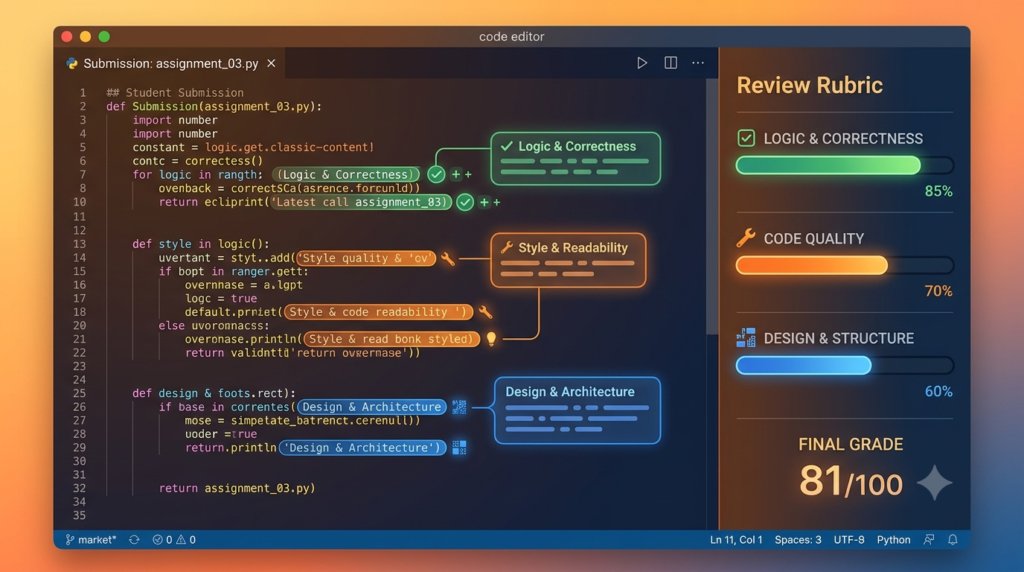
An AI-powered tool that provides instant, pedagogically-structured feedback on student code assignments for CS instructors.
Intermediate
Automated Code Review for Student Submissions
A product that gives CS instructors an AI-powered code review assistant specifically designed for student assignments — providing instant, structured feedback that teaches rather than just grades.
Who Is This For?
CS instructors and TAs who spend hours reviewing student code submissions
Teaching assistants who need consistent grading criteria across sections
Coding bootcamp instructors managing large cohorts with limited review capacity
Self-taught developers who want structured feedback on practice exercises
The Problem
Computer science instructors routinely spend 15-30 minutes reviewing each student’s code submission. In a class of 200 students with weekly assignments, that’s 50-100 hours of manual review per week. The result: delayed feedback, inconsistent grading, and burned-out TAs.
Most existing tools handle this by either (1) running unit tests to check correctness, or (2) using linters for style. Neither approach evaluates whether the student understood the concept, wrote readable code, or made appropriate design choices. A submission can pass all tests while using terrible variable names, duplicating logic everywhere, or ignoring edge cases.
The gap: students need feedback on code quality, readability, and design decisions — not just correctness. Instructors need this feedback delivered in a pedagogically structured way that teaches, not just a grade that penalizes.
How It Works
The tool analyzes each student submission against the assignment specification and provides structured feedback across four dimensions:
Correctness — Does the solution meet the assignment requirements? Does it handle edge cases? Are there logic errors?
Code quality — Is the code readable? Are naming conventions followed? Is there unnecessary complexity or duplication?
Design decisions — Does the student choose appropriate data structures? Is the algorithm efficient for the problem size?
Learning signals — Does the submission show understanding of the concepts being taught? Are there patterns suggesting the student copied code or used AI without understanding?
Assignment parsing — The instructor provides the assignment specification (description, test cases, expected behavior). The tool extracts requirements and evaluation criteria.
Multi-layer analysis — The student code is analyzed for correctness (test execution), quality (AST analysis), design (pattern detection), and learning signals (concept mapping).
LLM enrichment — An LLM generates human-readable feedback explanations, identifies specific lines with issues, and suggests improvements with educational context.
Structured report — Output is a rubric-aligned feedback report with strengths, areas for improvement, and specific code references.
Feedback Structure
Correctness (4/5)
All test cases pass
Handles null input correctly
Missing: edge case for empty list (line 23)
Code Quality (3/5)
Variable naming is clear
Function length is appropriate
Issue: duplicate logic in lines 45-52 (could extract to helper)
Design (4/5
Appropriate use of hash map for O(1) lookup
Good separation of concerns
Consider: early return pattern for readability
Learning Observation
Demonstrates understanding of recursion
Could benefit from practicing with memoization patterns
Key Features
Rubric-aligned feedback — Feedback maps to the instructor’s grading criteria
Multi-language support — Python, JavaScript, Java, C++, and Go
Similarity detection flags — Identifies submissions with patterns suggesting copying or AI-generated code that the student may not understand
Batch processing — Reviews an entire class of submissions in minutes
TA consistency — Ensures all students receive the same quality of feedback regardless of which TA reviews them
LMS integration — Connects with Canvas, Gradescope, or custom LMS via API
Student-facing output — Generates feedback in a format students can learn from, not just a grade
Test execution | Docker containers | Sandboxed, safe test running
LLM | Claude API | High-quality pedagogical feedback
Backend | FastAPI | Fast, async, good for batch processing
Frontend | React | Dashboard and student feedback viewer
Database | PostgreSQL | Submission and feedback storage
Queue | Redis + Celery | Async batch processing
MVP Scope
Python assignment support (FastAPI backend)
Instructor uploads assignment spec + test cases
Batch upload student submissions via ZIP
Rubric-aligned feedback generation
Student-facing feedback report
Basic plagiarism detection (code similarity)
Implementation Approach
Phase 1: Core Engine (Weeks 1-3)
Build the Python code analysis engine. Extract AST, run test cases in Docker containers, and generate basic correctness feedback. Add LLM-powered quality and design feedback.
Phase 2: Feedback Pipeline (Weeks 4-5)
Build the structured feedback report system. Create rubric-aligned output format. Implement batch processing with Celery queues.
Phase 3: Dashboard (Weeks 6-7)
Build the instructor dashboard for uploading assignments and viewing class-wide analytics. Add student-facing feedback viewer.
Phase 4: Multi-Language (Weeks 8-10)
Extend to JavaScript, Java, C++, and Go using Tree-sitter parsers. Add language-specific quality rules and design pattern detection.
Challenges and Tradeoffs
Assignment diversity — CS assignments vary wildly in structure, requirements, and evaluation criteria. The tool must be flexible enough to handle different assignment types.
False positives — The LLM might flag correct code as problematic or miss actual issues. Mitigate with confidence scoring and instructor review options.
Plagiarism detection — Detecting AI-generated code that a student submits without understanding is hard. The tool should flag patterns but not make accusations.
Rubric alignment — Different instructors grade differently. The tool must respect the instructor’s rubric, not impose a generic one.
Why This Idea Is Different
Existing code review tools (CodeRabbit, Codacy, SonarQube) are designed for professional codebases, not student submissions. They focus on production code quality, not pedagogical feedback. Gradescope handles grading but focuses on test execution, not code quality.
This Idea is specifically designed for the education context: rubric-aligned, pedagogically structured, batch-processed for class sizes, and focused on teaching rather than just grading. The plagiarism detection and learning signal analysis are unique to educational use cases.
What Similar Tools Exist
Tool
Focus | Limitation for Education
| Gradescope | Automated grading | Test execution only, no quality feedback
CodeRabbit | PR review for teams | Not designed for student assignments
SonarQube | Code quality for production | Too complex for learning context
GitHub Copilot | Code generation | Doesn’t review student work
This Idea fills the gap between automated grading (correctness only) and professional code review tools (not pedagogically structured).
Technology Stack
Python 3.11+ — Backend and code analysis
Tree-sitter — Multi-language AST parsing
FastAPI — REST API backend
React — Instructor dashboard and student feedback viewer
Claude API — Pedagogical feedback generation
Docker — Sandboxed test execution
PostgreSQL — Submission and feedback storage
Redis + Celery — Async batch processing
pytest — Testing
Future Extensions
Auto-grading — Combine feedback with automated scoring based on the rubric
Progress tracking — Track student improvement over the semester
Curriculum alignment — Map submissions to course learning objectives
Peer review — Use AI feedback to facilitate structured peer review
Learning analytics — Identify class-wide concepts that need re-teaching
IDE plugin — Real-time feedback as students write code
A research project that makes recovery a first-class evaluation object: injecting controlled, sandboxed unsafe-execution events into agent benchmarks and measuring...
A research project that audits the measurement instruments themselves: applying the ABC validity-checklist methodology to agent-security benchmarks to find task-validity...
A team of developers, researchers, and innovators who review and publish practical ideas for builders and creators.
Published: September 3, 2026
Editorial Note: This idea was reviewed and published by the ItsMyIdeas editorial team. All content is checked for originality, accuracy, and practical value before publication.
A team of developers, researchers, and innovators who review and publish practical ideas for builders and creators.
Published: September 3, 2026
Editorial Note: This idea was reviewed and published by the ItsMyIdeas editorial team. All content is checked for originality, accuracy, and practical value before publication.