Personal Credit Score Simulator
A beginner-friendly web application that lets users model how common financial actions might affect their credit score — providing interactive, hypothetical scenarios that help people understand the factors influencing credit scores without risking their actual credit.
Who Is This For?
- Young adults building credit for the first time who want to understand how their actions affect their score
- Financial literacy educators teaching students about credit and personal finance
- Anyone preparing for a major financial decision (buying a car, applying for a mortgage) who wants to understand the impact
- Personal finance enthusiasts who want a tool to explore credit score scenarios
- Parents teaching teenagers about responsible credit use
The Problem
Credit scores feel opaque to most people. The FICO score range (300-850) influences interest rates, loan approvals, rental applications, and even insurance premiums — yet most people don’t understand what specifically affects their score or by how much.
Common confusion:
- “Will paying off my credit card improve my score?”
- “How much will opening a new card hurt my score?”
- “Should I close my oldest account?”
- “What’s the ideal credit utilization ratio?”
Generic financial literacy content explains the five FICO factors (payment history 35%, amounts owed 30%, length of history 15%, new credit 10%, credit mix 10%) but doesn’t help people understand how these factors apply to their specific situation. A simulator that lets users model their own scenarios bridges the gap between abstract financial education and personalized understanding.
The core challenge: credit scoring is intentionally opaque (Fair Isaac Corporation doesn’t publish the exact FICO algorithm), and actual credit reports are managed by credit bureaus (Equifax, Experian, TransUnion) with complex, proprietary scoring models. Any simulator must be transparent about its limitations.
How It Works
User Input
The user provides a simplified credit profile:
| Input | Type | Description |
|——-|——|————-|
| Current score range | Slider (300-850) | User’s approximate current score |
| Number of credit cards | Number | Active credit cards |
| Total credit limit | Currency | Sum of all card limits |
| Current balance | Currency | Sum of all card balances |
| Oldest account age | Years | Age of oldest credit account |
| Number of accounts | Number | Total open credit accounts |
| Recent hard inquiries | Number | In the last 12 months |
| Payment history | Select | Excellent / Good / Fair / Poor |
Scenario Modeling
The user then explores “what if” scenarios:
| Scenario | What Changes |
|———-|————-|
| Pay off a credit card | Balance decreases, utilization drops |
| Open a new account | New account added, average age decreases, hard inquiry added |
| Close an old account | Average age decreases, total limit decreases |
| Miss a payment | Payment history affected |
| Increase credit limit | Total limit increases, utilization drops |
| Pay down balance by $X | Balance decreases by specified amount |
Score Estimation
The tool estimates the score impact based on the publicly documented FICO factor weights:
Estimated Score Change = Σ (Factor Weight × Impact Magnitude)
Where:
- Payment history (35%) — Missed payments have the largest negative impact. On-time payments have gradual positive impact.
- Amounts owed / utilization (30%) — High utilization (>30%) is negative; low utilization (<10%) is positive. The optimal utilization varies by bureau data.
- Length of credit history (15%) — Longer history is positive. Closing old accounts reduces average age.
- New credit (10%) — Hard inquiries cause small, temporary negative impact. Multiple inquiries in a short period may have compounding effect.
- Credit mix (10%) — Having different types of credit (cards, loans, mortgage) is mildly positive.
Important disclaimer: The FICO algorithm is proprietary. This simulator uses publicly documented factor weights and published research (MyFICO.com, Consumer Financial Protection Bureau) to provide estimates, not predictions. Actual score changes depend on the specific scoring model, bureau data, and individual credit history.
Visualization
The tool provides visual feedback:
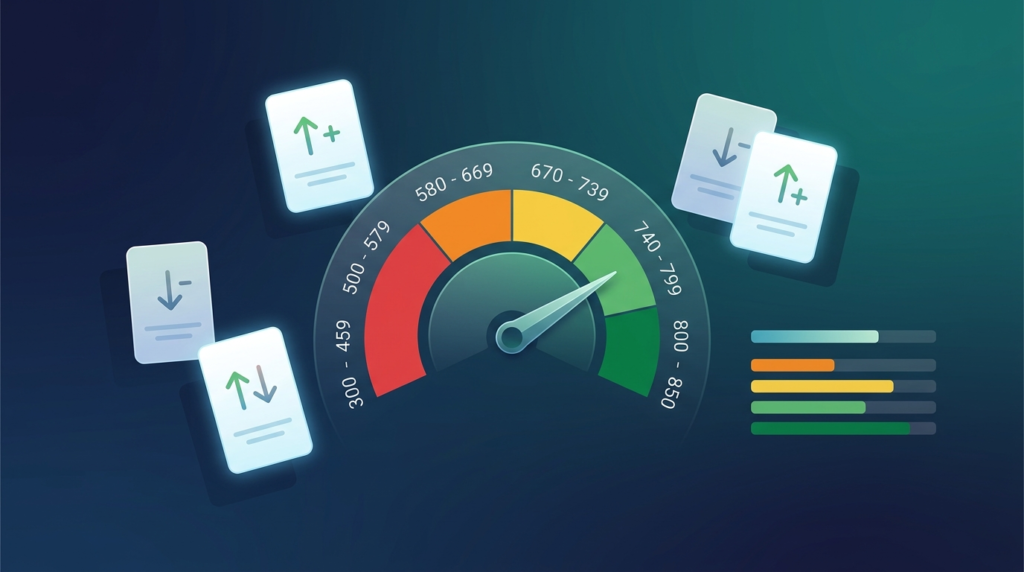
Score gauge — A dial showing the estimated score (300-850) with color bands (poor/fair/good/very good/exceptional)Factor breakdown — Horizontal bars showing how each factor contributes to the current scoreScenario comparison — Side-by-side view of current score vs. projected score after a scenarioTimeline — A chart showing estimated score trajectory over 6-12 months as scenarios are appliedFactor explanations — Expandable cards explaining each factor with actionable tipsCore Workflow
Enter Profile → Explore Scenarios → See Estimated Impact → Learn Why → Make Informed Decisions
Profile setup — User enters their current credit profile (5 minutes)Scenario exploration — User selects “what if” actions and sees estimated score changesComparison — User compares multiple scenarios side-by-sideLearning — Each scenario includes an explanation of why the score changesEducation — Links to authoritative resources (CFPB, MyFICO) for deeper learningKey Features
- Interactive scenario modeling — “What if I pay off this card?” with instant estimated impact
- Factor breakdown — Visual representation of how each FICO factor contributes to the score
- Scenario comparison — Side-by-side comparison of multiple financial actions
- Score trajectory — Estimated score changes over 6-12 months
- Educational explanations — Every scenario includes a plain-language explanation of the underlying credit factor
- No account required — Use the simulator without creating an account
- No financial data collection — The tool doesn’t collect real financial information; all inputs stay in the browser
- Privacy-first — All calculations happen client-side; no data is sent to a server
- Responsive design — Works on desktop and mobile
- Accessibility — WCAG 2.1 AA compliant with screen reader support
Technical Architecture
┌─────────────────────────────────────────────┐ │ User's Browser │ │ (All calculations happen client-side) │ ├─────────────────────────────────────────────┤ │ │ │ ┌─────────────┐ ┌──────────────────┐ │ │ │ Profile │ │ Scenario Engine │ │ │ │ Input │───▶│ (JavaScript) │ │ │ └─────────────┘ └────────┬─────────┘ │ │ │ │ │ ┌─────────▼─────────┐ │ │ │ Score Estimator │ │ │ │ (FICO factor │ │ │ │ weighting model) │ │ │ └─────────┬─────────┘ │ │ │ │ │ ┌─────────────┐ ┌───────▼──────────┐ │ │ │ Educational │◀───│ Visualization │ │ │ │ Content │ │ (Recharts/D3) │ │ │ └─────────────┘ └──────────────────┘ │ │ │ └─────────────────────────────────────────────┘
Technology Choices
| Component | Technology | Why |
|———–|———–|—–|
| Frontend | React | Interactive UI, state management |
| Charts | Recharts | Accessible, React-native charts |
| Calculations | JavaScript (client-side) | Privacy — no server needed |
| State management | React Context | Simple state for profile and scenarios |
| Styling | CSS + design tokens | Lightweight, accessible |
| Deployment | Static hosting (Vercel/Netlify) | Zero infrastructure cost |
| Analytics | Privacy-friendly (Plausible) | No tracking, GDPR compliant |
Note: This is a client-side-only application. No backend server is needed for the MVP. All calculations happen in the browser. This is a deliberate privacy choice — users’ financial data never leaves their device.
MVP Scope
Credit profile input form (7 fields)Scenario selector with 6 common financial actionsScore estimation engine using FICO factor weightsScore gauge visualization (300-850 range)Factor breakdown barsScenario comparison viewEducational explanations for each factorResponsive designNo account required, no data collectionImplementation Approach
Phase 1: Core Engine (Weeks 1-2)
Build the credit profile input form and score estimation engine. Implement the FICO factor weighting model. Create the score gauge visualization.
Phase 2: Scenario Engine (Weeks 3-4)
Implement the scenario modeling system. Build the scenario selector with 6 common actions. Add the comparison view and score trajectory chart.
Phase 3: Education and Polish (Weeks 5-6)
Write educational content for each factor. Add expandable explanation cards. Implement responsive design and accessibility features.
Phase 4: Launch (Week 7)
Deploy to static hosting. Add privacy-friendly analytics. Create landing page. Submit to Product Hunt and Hacker News.
Challenges and Tradeoffs
- Scoring accuracy — The FICO algorithm is proprietary. The simulator uses publicly documented factor weights, but actual score changes may differ. The tool must be transparent about this limitation.
- Model complexity — Different scoring models (FICO 8, FICO 9, VantageScore) weigh factors differently. The simulator uses a simplified model that represents general FICO behavior.
- Edge cases — Thin credit files (few accounts) behave differently than thick files. The simulator should handle edge cases gracefully.
- User expectations — Some users may expect the simulator to predict their exact score. The tool must clearly communicate that it provides estimates, not predictions.
Financial Safety
Important Disclaimers
This tool provides educational estimates, not financial advice.
- The FICO scoring algorithm is proprietary. This simulator uses publicly documented factor weights to provide rough estimates.
- Actual credit scores depend on the specific scoring model (FICO 8, FICO 9, VantageScore 3.0/4.0), the credit bureau (Equifax, Experian, TransUnion), and individual credit history details.
- Estimated score changes are approximations based on published research, not guarantees.
- The simulator does not access, store, or transmit any real financial information.
- Users should not make financial decisions based solely on simulator estimates.
- For accurate credit scores, users should obtain their score from a credit bureau or a service like AnnualCreditReport.com.
What This Tool Is NOT
- Not a credit monitoring service — It doesn’t track your actual score
- Not financial advice — It doesn’t recommend specific financial actions
- Not a loan application — It doesn’t connect to lenders
- Not a credit repair tool — It doesn’t dispute errors or negotiate with creditors
- Not affiliated with FICO, Equifax, Experian, or TransUnion
Privacy
- All calculations happen client-side in the user’s browser
- No user data is sent to any server
- No cookies are used for tracking
- No account creation is required
- The tool is fully functional without internet connection after initial load
Why This Idea Is Different
Existing credit score simulators (Credit Karma, WalletHub, NerdWallet) require account creation, connect to credit bureaus, and show your actual score. They’re useful but require trust and data sharing.
This Idea takes a different approach: a fully client-side simulator that requires no account, no data sharing, and no credit bureau connection. It’s designed for education, not for monitoring. The privacy-first architecture makes it accessible to people who are cautious about sharing financial information online.
The beginner-friendly target audience is also different. Most credit tools are designed for people who already have credit and want to optimize. This tool is designed for people who are learning about credit for the first time.
| Tool | Approach | Limitation |
|——|———-|————|
| Credit Karma | Free credit monitoring | Requires account and credit bureau connection |
| WalletHub | Credit score simulator | Requires account; shows actual score |
| NerdWallet | Credit score tracking | Requires account; focused on product recommendations |
| FICO score estimator | Basic calculator | Very limited scenarios; no education |
This Idea fills the gap between “check your actual score” tools and “read about credit factors” articles.
Technology Stack
- React 18 — Interactive UI framework
- Recharts — Accessible data visualization
- JavaScript — Client-side calculations (no backend)
- CSS — Styling with design tokens
- Vercel — Static hosting and deployment
- Plausible Analytics — Privacy-friendly analytics (no cookies)
Future Extensions
- Credit card comparison — Show how different cards might affect the user’s score
- Mortgage readiness estimator — Estimate readiness for mortgage application
- Debt payoff calculator — Model debt payoff strategies and their credit impact
- Multi-scenario planning — Build complex multi-step scenarios
- Educational quiz — Test credit knowledge with interactive quizzes
- Localized scoring models — Add support for non-US credit scoring systems (VantageScore, UK, Canada)
- Offline mode — Full functionality without internet after first load
Browse more Finance ideas · Startup Ideas · Beginner Ideas