Project Idea · Intermediate · Python, Machine Learning
Problem Statement
Manual code review is one of the biggest bottlenecks in software development. Teams spend hours reviewing pull requests, often missing subtle bugs, security issues, or code quality problems. Studies suggest that the average developer spends 4-8 hours per week on code review — time that could be spent building features.
The problem is not that human review is unnecessary, but that it is inconsistent. Review quality depends on the reviewer’s experience, attention, and familiarity with the codebase. Critical issues get missed. Style feedback dominates over substance. And junior developers wait hours for feedback that an automated system could provide in seconds.
Proposed Solution
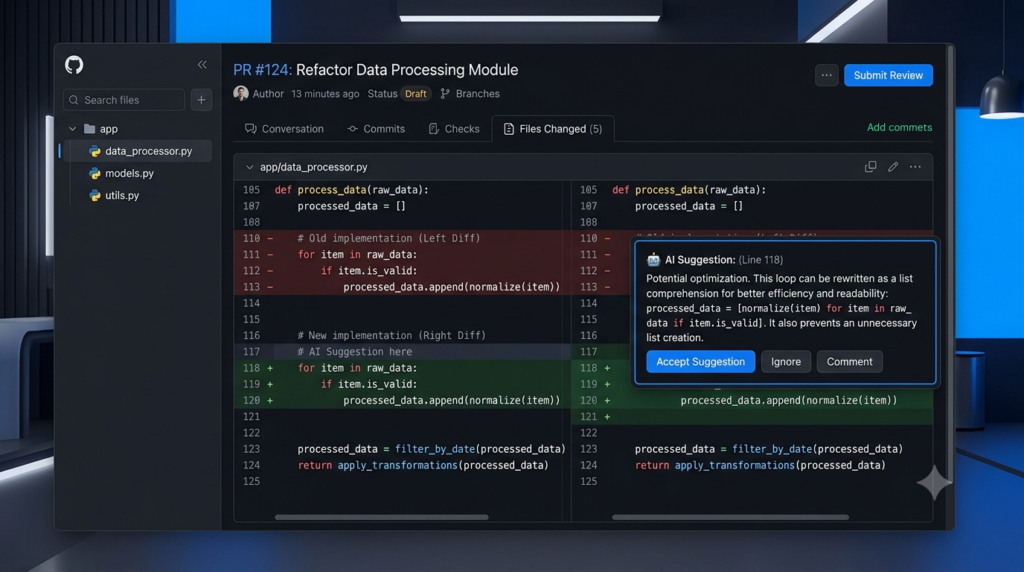
Build an AI-powered code review assistant specifically designed for Python codebases. The tool analyzes pull requests when they are opened, runs intelligent static analysis, and posts inline comments with actionable suggestions.
Unlike traditional linters that check style rules, this assistant understands context. It can detect logical errors, suggest performance improvements, identify potential security vulnerabilities, and recommend architectural changes — all based on the specific code being reviewed, not just generic rules.
Why This Idea Matters
Code quality directly impacts software reliability, maintainability, and team velocity. An AI review assistant acts as a tireless, consistent reviewer that never has a bad day, never skips edge cases, and provides instant feedback. For teams without senior developers available for every review, this fills a critical gap.
The tool does not replace human reviewers — it augments them. By handling the mechanical checks and surfacing the hardest issues, it lets human reviewers focus on design decisions, business logic, and architectural concerns.
Key Features
- Pull request integration — Connects to GitHub/GitLab and automatically reviews new PRs
- Inline comments — Posts specific suggestions directly on the relevant lines of code
- Bug detection — Identifies logic errors, null pointer risks, race conditions, and resource leaks
- Code smell analysis — Detects duplicated code, overly complex functions, and poor naming
- Security scanning — Flags common Python security issues (SQL injection, path traversal, insecure deserialization)
- Performance suggestions — Identifies inefficient algorithms, unnecessary database queries, and memory concerns
- Severity levels — Classifies issues as critical, warning, or suggestion
- Learning mode — Adapts to team coding standards over time
How It Works
- Developer opens a pull request
- The assistant clones the branch and runs analysis on changed files
- An LLM-powered analyzer reviews code context, not just syntax
- Findings are posted as inline PR comments with suggested fixes
- Developer reviews suggestions and applies approved changes
- The system tracks which suggestions were accepted to improve over time
Implementation Approach
Phase 1: MVP (4-6 weeks)
Build a GitHub App that receives webhook events on pull request creation. Use Python AST parsing to extract changed functions. Send code context to an LLM API (GPT-4 or Claude) with a carefully engineered prompt that requests structured review output. Parse the response and post inline comments via the GitHub API.
Phase 2: Core Intelligence (4-6 weeks)
Implement pattern matching for security vulnerabilities using known vulnerability databases. Add support for detecting test coverage gaps in changed code. Build a team configuration system for custom rules and severity thresholds. Integrate with multiple LLM providers for redundancy and cost optimization.
Phase 3: Scale & Polish (4-6 weeks)
Add GitLab support. Implement caching to avoid re-reviewing unchanged code. Build a dashboard showing review metrics and team trends. Add Slack notifications for critical findings.
Technology Stack
- Python 3.11+ — Core runtime
- FastAPI — Webhook handler and API
- GitHub API / GitLab API — PR integration
- LLM API (GPT-4 / Claude) — Code understanding and review generation
- PostgreSQL — Review history and team settings
- Redis — Caching and job queue
- Docker — Deployment containerization
Potential Challenges
- LLM costs — Each review requires API calls; costs scale with PR volume. Mitigation: only analyze changed functions, cache results, use smaller models for simple checks.
- False positives — Incorrect suggestions erode trust. Mitigation: confidence scoring, team feedback loop, conservative threshold for critical issues.
- Context window limits — Large PRs may exceed LLM context. Mitigation: chunk analysis by file, summarize cross-file context.
- Latency — Developers expect fast feedback. Mitigation: async processing, background analysis, notifications when complete.
Future Extensions
- Support for additional languages (JavaScript, Go, Rust)
- Custom rule engine for team-specific patterns
- Integration with issue trackers for automatic bug creation
- Code metrics dashboard (complexity trends, review coverage)
- Auto-fix capability for simple issues
- VS Code extension for local pre-push review
FAQ
Who can build this?
A developer comfortable with Python, API integrations, and LLM prompt engineering. No ML training experience is required for the MVP — the LLM does the heavy lifting.
What is the minimum viable version?
A GitHub App that reviews PRs on a single repository, posting inline comments with suggestions. This can be built in 4-6 weeks by an experienced developer.
Can this be monetized?
Yes. Potential models include a free tier for open-source repos and a paid tier for private repos and teams. Developer tools is an active market with willingness to pay for quality.
What makes this different from existing linting tools?
Linters check style rules. This tool understands context and intent. It can evaluate whether a function’s logic is correct, not just whether it follows formatting conventions. It operates at the semantic level, not the syntactic level.
What are the main challenges?
Managing LLM costs, reducing false positives, and achieving fast enough response times. All are solvable with the phased approach described above.