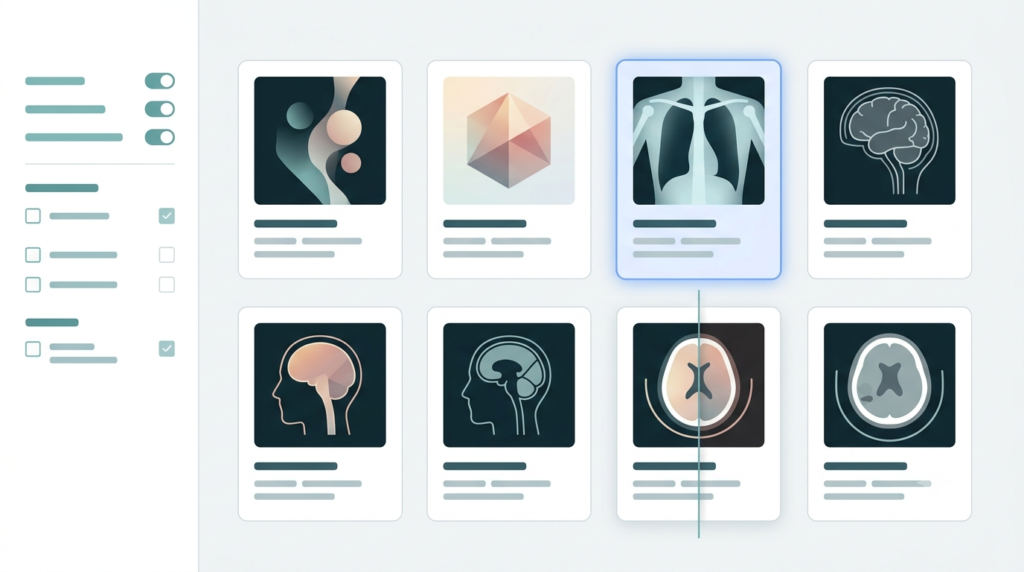
Open-Source Medical Dataset Explorer for AI Researchers
A research-oriented tool that helps AI and ML researchers discover, evaluate, compare, and access publicly available medical datasets — providing structured metadata, quality indicators, and licensing information in a unified explorer.
Who Is This For?
- AI/ML researchers working on medical imaging, clinical NLP, or health informatics who need suitable training datasets
- Graduate students starting medical AI projects who don’t know which datasets are available or appropriate
- Medical informatics teams at hospitals and research institutions evaluating data sources for collaboration
- Open-data advocates cataloging and promoting responsible use of medical datasets
- Biotech startups exploring medical AI applications who need to understand the data landscape
The Problem
Medical AI research depends on access to suitable datasets, but finding the right dataset is surprisingly difficult. Medical datasets are scattered across dozens of repositories, institutional portals, government databases, and supplementary materials in research papers. There is no centralized, well-organized explorer that helps researchers find datasets by the criteria that matter most to them.
The challenges researchers face:
- Discovery — Knowing what datasets exist. A researcher looking for chest X-ray datasets for pneumonia detection might find 5 different sources without knowing which is most appropriate.
- Evaluation — Understanding dataset quality. Sample size alone doesn’t indicate quality — annotation methodology, patient demographics, imaging equipment, and clinical context all matter.
- Comparison — Choosing between similar datasets. Two chest X-ray datasets might differ in size, annotation granularity, label quality, and licensing — but this information is buried in separate papers.
- Access — Understanding requirements. Some datasets are publicly downloadable; others require institutional approval, data use agreements, or compliance with specific regulations.
- Licensing — Navigating complex licensing terms. A dataset might be free for research but not for commercial use, or require attribution in specific ways.
- Reproducibility — Tracking dataset versions. Datasets are updated, and researchers need to know which version was used in published results.
The result: researchers spend days or weeks manually searching for and evaluating datasets — time that could be spent on actual research.
How It Works
The tool aggregates metadata from major medical dataset repositories and provides a unified search and comparison interface.
Data Sources
| Repository | Type | Datasets | Access |
|————|——|———-|——–|
| NIH Clinical Center | Imaging, genomic | 50+ | Public download |
| MIMIC (PhysioNet) | Clinical records, waveforms | 10+ | Controlled access |
| Kaggle Medical | Imaging, tabular | 100+ | Public download |
| Zenodo Medical | Mixed | 200+ | Public download |
| Harvard Dataverse | Mixed | 50+ | Varies |
| TCIA (Cancer Imaging Archive) | Medical imaging | 80+ | Public download |
| UCI Machine Learning Repository | Tabular health data | 20+ | Public download |
| WHO Global Health Observatory | Population health | 100+ | Public download |
Metadata Schema
For each dataset, the explorer collects and displays:
| Metadata Field | Description | Example |
|—————-|————-|———|
| Name | Official dataset name | CheXpert |
| Source | Repository or publisher | Stanford ML Group |
| Modality | Data type | Chest X-ray images |
| Condition | Medical condition or task | Multi-label pathology classification |
| Sample size | Number of records/samples | 224,316 images |
| Patient count | Unique patients | 65,240 patients |
| Demographics | Age, sex, ethnicity distribution | Adults 18-90, balanced sex |
| Annotation type | How labels were created | NLP-derived from radiology reports |
| Annotation quality | Inter-annotator agreement, expert review | Board-certified radiologist review |
| Imaging equipment | Scanner make/model where applicable | X-ray, various manufacturers |
| Geographic context | Where data was collected | United States, single institution |
| License | Usage terms | Research only, CC BY 4.0 |
| Access method | How to obtain | Direct download, registration required |
| File format | Data format | DICOM, PNG, CSV |
| Size on disk | Storage requirement | ~12 GB |
| Publication | Associated paper | CheXpert paper (Irvin et al., 2019) |
| Citation count | Academic impact indicator | 800+ citations |
| Last updated | Freshness indicator | 2023 |
| Version | Dataset version | v1.0 |
Search and Filtering
The explorer supports multi-faceted filtering:
┌─────────────────────────────────────────────┐ │ Search: [chest x-ray pneumonia ] │ ├─────────────────────────────────────────────┤ │ Modality: [✓] Imaging [ ] Tabular │ │ [ ] Waveform [ ] Text │ │ │ │ Condition: [✓] Respiratory [ ] Cardiac │ │ [ ] Neurological [ ] Oncology │ │ │ │ Min samples: [10,000 ] │ │ License: [✓] Public [ ] Controlled │ │ Access: [✓] Download [ ] Registration │ │ Format: [✓] DICOM [✓] PNG │ │ │ │ [Search] [Reset Filters] │ └─────────────────────────────────────────────┘
Dataset Comparison
Select 2-3 datasets for side-by-side comparison:
| Attribute | CheXpert | MIMIC-CXR | NIH Chest X-ray |
|———–|———-|———–|—————–|
| Samples | 224,316 | 377,110 | 112,120 |
| Patients | 65,240 | 63,479 | 30,805 |
| Labels | 14 pathologies | 14 pathologies | 14 pathologies |
| Annotation | NLP from reports | NLP from reports | NLP from reports |
| License | Research only | PhysioNet Credentialed | Public domain |
| Access | Direct download | Application required | Direct download |
Quality Indicators
The explorer assigns quality indicators based on available metadata:
| Indicator | Criteria | Meaning |
|———–|———-|———|
| ⭐ High quality | Large sample, expert annotation, well-cited | Strong choice for research |
| ✅ Good quality | Moderate sample, clear documentation | Suitable for most research |
| ⚠️ Use with caution | Small sample, limited documentation | Verify before relying on |
| 🔒 Restricted access | Requires approval or DUA | Plan for access timeline |
Core Workflow
Research Question → Dataset Search → Filter & Compare → Access Requirements → Download/Apply → Research
Define need — What medical task are you researching? What modality? What minimum sample size?Search — Enter keywords or use faceted filters to narrow resultsCompare — Select promising datasets for side-by-side comparisonEvaluate — Review quality indicators, documentation, and licensingAccess — Understand access requirements (download, registration, DUA)Cite — Get the correct citation for the dataset version usedKey Features
- Unified search — Search across medical datasets from multiple major repositories
- Faceted filtering — Filter by modality, condition, sample size, license, format, and access method
- Dataset comparison — Side-by-side comparison of 2-3 datasets on key attributes
- Quality indicators — Automated quality scoring based on metadata completeness and citation impact
- Licensing clarity — Clear display of usage terms, restrictions, and attribution requirements
- Citation generator — Auto-generate proper citations in APA, MLA, and BibTeX formats
- Version tracking — Track dataset versions and changes over time
- Bookmark collections — Save datasets to personal collections for project reference
- API access — Programmatic access to dataset metadata for integration into research workflows
- Community contribution — Researchers can submit new datasets or corrections to existing metadata
Technical Architecture
┌─────────────────────────────────────────────┐ │ Data Source Repositories │ │ (NIH, PhysioNet, Kaggle, Zenodo, etc.) │ └──────────────────┬──────────────────────────┘ │ (Scrapers + API clients) ┌─────────▼─────────┐ │ Metadata Ingestion│ │ (ETL Pipeline) │ └─────────┬─────────┘ │ ┌─────────▼─────────┐ │ Structured DB │ │ (PostgreSQL + │ │ Elasticsearch) │ └─────────┬─────────┘ │ ┌──────────────┼──────────────┐ │ │ │ ┌───▼───┐ ┌────▼────┐ ┌────▼────┐ │ Search │ │ Compare │ │ API │ │& Browse│ │ Engine │ │ Server │ └───────┘ └─────────┘ └─────────┘
Technology Choices
| Component | Technology | Why |
|———–|———–|—–|
| Backend | Python + FastAPI | ML/data ecosystem, fast development |
| Database | PostgreSQL | Structured metadata, relational queries |
| Search | Elasticsearch | Full-text search, faceted filtering |
| Scrapers | Scrapy + BeautifulSoup | Multi-source metadata collection |
| Frontend | React | Interactive search and comparison UI |
| API | FastAPI | RESTful programmatic access |
| Deployment | Docker + PostgreSQL | Self-hosted research tool |
MVP Scope
Metadata ingestion from NIH, Kaggle, and TCIA repositoriesSearch with modality, condition, and sample size filtersDataset detail pages with full metadataSide-by-side comparison of 2 datasetsQuality indicators based on metadata completenessCitation generator (APA, BibTeX)Basic API for programmatic metadata accessImplementation Approach
Phase 1: Data Collection (Weeks 1-3)
Build scrapers for NIH, Kaggle, and TCIA. Design the metadata schema. Implement the ingestion pipeline with deduplication and versioning. Store in PostgreSQL.
Phase 2: Search and Browse (Weeks 4-6)
Implement Elasticsearch indexing for full-text search. Build faceted filtering UI in React. Create dataset detail pages with all metadata fields.
Phase 3: Comparison and Quality (Weeks 7-9)
Build the dataset comparison engine. Implement quality indicator scoring. Add citation generation in multiple formats.
Phase 4: API and Polish (Weeks 10-11)
Build the REST API for programmatic access. Add bookmark collections. Implement contribution workflow for community submissions. Add version tracking.
Healthcare and Research Safety
This Is a Research Tool, Not a Clinical Tool
Important: This explorer helps researchers find datasets. It does not:
- Provide medical diagnoses
- Interpret medical images or data
- Recommend treatments
- Replace clinical decision-making
- Store patient data directly
Data Ethics Considerations
| Consideration | Guidance |
|—————|———-|
| Informed consent | Datasets should have been collected with appropriate informed consent. The explorer flags datasets where consent terms are unclear. |
| De-identification | Public datasets should be de-identified. The explorer notes whether de-identification methodology is documented. |
| Institutional review | Researchers using clinical data should have IRB approval. The explorer notes whether IRB review is documented for each dataset. |
| Bias awareness | Datasets may not represent diverse populations. The explorer displays demographic information where available. |
| Responsible use | Datasets should be used only for their intended purpose. The explorer clearly displays licensing terms and restrictions. |
Access Levels
| Level | Description | Examples |
|——-|————-|———-|
| Public download | Anyone can download immediately | NIH Chest X-ray, UCI datasets |
| Registration required | Free account needed | Kaggle, Zenodo |
| Credentialed access | Application and approval required | MIMIC (PhysioNet) |
| Controlled access | Data Use Agreement, institutional affiliation | Some genomic datasets |
| Restricted | Not available for download | Some clinical trial data |
The explorer clearly indicates the access level for each dataset and provides links to access applications where applicable.
Licensing Clarity
The explorer displays licensing in plain language:
| License Type | What It Means |
|————-|—————|
| Public Domain / CC0 | Free to use for any purpose |
| CC BY 4.0 | Free to use with attribution |
| CC BY-NC 4.0 | Free for non-commercial use with attribution |
| Research Only | Available only for academic research |
| Custom DUA | Specific Data Use Agreement required |
| Commercial license available | Contact publisher for commercial use |
Limitations
- Metadata completeness — Not all datasets have complete metadata. The explorer shows what’s available and flags gaps.
- Access changes — Dataset access terms can change. The explorer updates periodically but may lag behind changes.
- Not exhaustive — The explorer covers major repositories but may miss smaller or institutional datasets.
- Quality is subjective — Quality indicators are based on metadata, not expert evaluation of the actual data.
- Version tracking — Not all datasets provide version information. Version tracking is limited to datasets that explicitly version their releases.
Why This Idea Is Interesting
This Idea addresses a real workflow pain point in medical AI research. The growing number of medical datasets (driven by open-data initiatives and AI research demand) has created a discovery problem. Researchers need a structured way to find, evaluate, and compare datasets — not just a list of links.
The research angle is important: this is not a commercial product but a tool that enables better research methodology. By helping researchers find appropriate datasets and understand their limitations, the explorer supports more rigorous and reproducible medical AI research.
Browse more Health ideas · AI ideas · Research Ideas