Patient Medication Interaction Checker
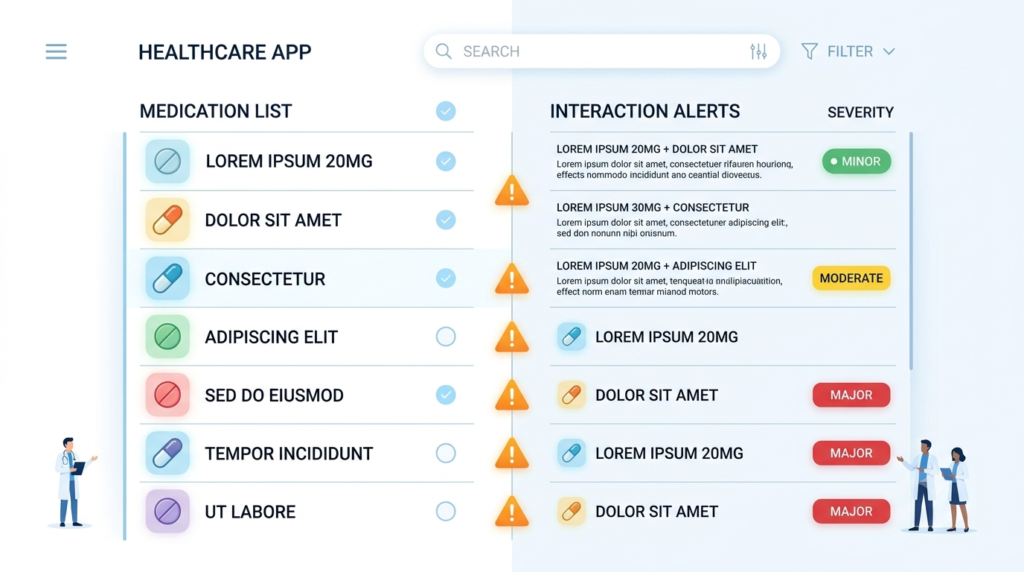
A tool that lets patients and caregivers enter their current medications and instantly check for dangerous interactions, duplications, and contraindications — providing a quick secondary safety check alongside professional pharmacy review.
Who Is This For?
- Patients taking multiple medications (polypharmacy) who want to verify safety before adding a new prescription
- Caregivers managing medications for elderly family members who take 5+ daily medications
- Pharmacists looking for a quick secondary-check tool during high-volume dispensing
- Health-conscious individuals who want to understand interaction risks before discussing changes with their doctor
The Problem
Approximately 52% of Americans take at least one prescription medication, and 12% take five or more. The more medications a person takes, the higher the risk of adverse drug interactions. According to the FDA, adverse drug events account for roughly 3.5 million physician office visits annually in the US.
Pharmacists check for interactions when dispensing, but the volume of prescriptions processed daily means the interaction check is typically a brief software alert review. Patients themselves rarely check interactions when adding over-the-counter medications, supplements, or new prescriptions from different doctors.
The gap: there’s no simple, patient-facing tool where someone can type in all their medications — prescriptions, OTC drugs, and supplements — and get a clear, understandable report of interaction risks.
How It Works
Medication entry — The patient enters their current medications by name (brand or generic). The tool uses a drug database to match entries and retrieve detailed interaction data.Interaction analysis — The system cross-references every medication pair against an interaction database, checking for severity levels (minor, moderate, major, contraindicated).Risk report — The patient receives a clear, jargon-free report showing which medications interact, how severe the interaction is, what symptoms to watch for, and whether to contact their doctor.Interaction Severity Levels
| Level | Meaning | Patient Action |
|——-|———|—————-|
| Minor | Low risk, monitor | No immediate action needed |
| Moderate | Increased risk, caution | Discuss with pharmacist or doctor |
| Major | Significant risk | Contact doctor before continuing |
| Contraindicated | Do not combine | Stop and contact doctor immediately |
Core Workflow
Patient Medication List → Drug Database Lookup → Pairwise Interaction Check → Risk Report
Drug lookup — Match entered medication names against a drug database (OpenFDA, RxNorm). Handle brand names, generic names, and common abbreviations.Pairwise check — For every pair of medications, query the interaction database for known interactions. For N medications, check N*(N-1)/2 pairs.Severity scoring — Assign severity levels based on interaction evidence strength and clinical significance.Report generation — Produce a clear report grouping interactions by severity, with plain-language explanations.Key Features
- Multi-source medication entry — Accept brand names, generic names, and common abbreviations
- Prescription + OTC + supplements — Check interactions across all medication types, not just prescriptions
- Plain-language explanations — Convert medical jargon into patient-understandable descriptions
- Severity grading — Four-level severity system aligned with clinical standards
- “What to watch for” — Lists specific symptoms that might indicate an interaction is occurring
- Printable report — Generate a PDF report to bring to doctor appointments
- Medication list management — Save and update medication lists over time
- Interaction history — Track which interactions have been previously reviewed
Technical Architecture
┌─────────────────────────────────────────────┐ │ Patient Input Interface │ │ (Medication name entry, list management) │ └──────────────────┬──────────────────────────┘ │ ┌─────────▼─────────┐ │ Drug Name Resolver│ │ (Fuzzy matching, │ │ RxNorm lookup) │ └─────────┬─────────┘ │ ┌─────────▼─────────┐ │ Interaction Engine │ │ (Pairwise check, │ │ severity scoring) │ └─────────┬─────────┘ │ ┌──────────────┼──────────────┐ │ │ │ ┌───▼───┐ ┌────▼────┐ ┌────▼────┐ │Report │ │Drug │ │History │ │Builder│ │Database │ │Store │ └───────┘ └─────────┘ └─────────┘
Technology Choices
| Component | Technology | Why |
|———–|———–|—–|
| Drug database | OpenFDA + RxNorm API | Free, authoritative, regularly updated |
| Interaction data | DrugBank (public subset) | Comprehensive interaction database |
| Backend | Python + FastAPI | Fast API, good data processing |
| Database | PostgreSQL | Structured drug and interaction data |
| Fuzzy matching | RapidFuzz | Handle misspellings and abbreviations |
| Frontend | React | Clean, accessible patient interface |
| PDF generation | WeasyPrint | Server-side PDF for printable reports |
MVP Scope
Medication entry with name resolution (brand + generic)Pairwise interaction check against drug interaction databaseFour-level severity report with plain-language explanationsMedication list save/load (local storage or account)Printable PDF report generationBasic symptom watch-for list per interactionImplementation Approach
Phase 1: Drug Data Layer (Weeks 1-3)
Build the drug name resolver using OpenFDA and RxNorm APIs. Create a local cache of common medications with their interaction profiles. Implement fuzzy matching for medication name entry.
Phase 2: Interaction Engine (Weeks 4-5)
Build the pairwise interaction checking logic. Implement severity scoring based on interaction evidence. Create the plain-language explanation generator.
Phase 3: Patient Interface (Weeks 6-7)
Build the React frontend with medication entry, list management, and report display. Add the printable PDF report generation. Implement responsive design for mobile use.
Phase 4: Data Enhancement (Weeks 8-9)
Expand the interaction database with additional sources. Add supplement and OTC drug coverage. Implement interaction history tracking and medication list persistence.
Challenges and Tradeoffs
- Data completeness — The OpenFDA adverse event database is useful but not comprehensive. Some rare interactions may not appear. The tool must clearly state its limitations and recommend professional verification.
- Drug name variations — Medications have brand names, generic names, manufacturer names, and regional variations. The fuzzy matching must handle common variations without false matches.
- Supplement interactions — Herbal supplements and vitamins have fewer documented interactions in formal databases. The tool should acknowledge this limitation.
- Clinical context — Interactions depend on dosage, timing, patient age, kidney/liver function, and other factors the tool cannot assess. Reports must include appropriate disclaimers.
Healthcare Safety
This tool provides information only. It does not:
- Provide medical advice
- Replace pharmacist or doctor consultation
- Make treatment decisions
- Diagnose conditions
All interaction reports include a clear disclaimer recommending professional consultation. The tool is designed to help patients ask better questions, not to replace clinical judgment.
Regulatory considerations: This tool would likely be classified as a general wellness product rather than a medical device, but regulatory review is recommended before public deployment.
Why This Idea Is Different
Pharmacist interaction checkers exist (Lexicomp, Micromedex, Clinical Pharmacology) but are designed for healthcare professionals. Patient-facing alternatives exist as mobile apps (Medisafe, Drugs.com) but focus primarily on reminders and basic lookup rather than comprehensive interaction analysis.
This Idea focuses specifically on the interaction-checking workflow: enter all medications, get a complete interaction report. The plain-language explanations and printable doctor-appointment reports are designed for patients, not pharmacists.
| Tool | Focus | Limitation |
|——|——-|————|
| Drugs.com interaction checker | Basic lookup | Limited to 2-drug checks, not full list analysis |
| Medisafe | Medication reminders | Interaction check is secondary, not the focus |
| Lexicomp | Professional database | Designed for clinicians, not patients |
| WebMD interaction checker | Basic lookup | Limited depth, no PDF reports |
This Idea provides a complete multi-medication interaction analysis designed specifically for patient use.
Technology Stack
- Python 3.11+ — Backend and data processing
- FastAPI — REST API
- PostgreSQL — Drug and interaction data storage
- RapidFuzz — Medication name fuzzy matching
- React — Patient interface
- WeasyPrint — PDF report generation
- OpenFDA API — Drug data source
- RxNorm API — Drug name normalization
- pytest — Testing
Future Extensions
- Pharmacy integration — Import medication lists directly from pharmacy systems
- EHR integration — Pull current medications from electronic health records via FHIR
- Multilingual support — Medication names and explanations in multiple languages
- Age/weight-based dosing — Add basic dose-range checking for common medications
- Insurance formulary check — Verify whether medications are covered by insurance
- Caregiver dashboard — Manage medication lists for multiple family members
- API for developers — Provide an interaction-checking API for health apps
Browse more Healthcare ideas · Project Ideas