Privacy-First Offline Speech Transcription with Open Datasets
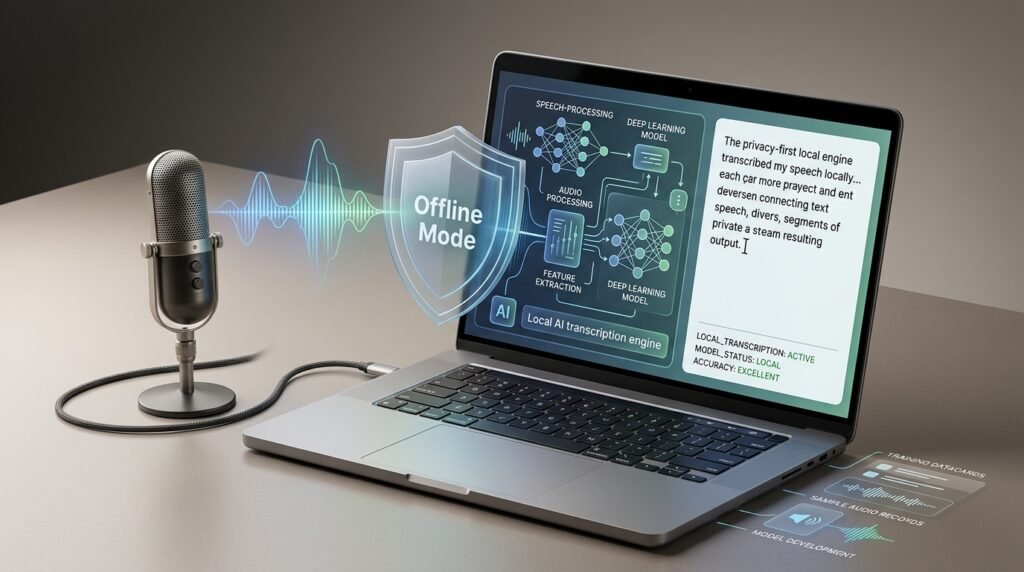
A product project that puts speech-to-text where the audio actually is: on your machine. The workbench ingests recordings, transcribes them with open, locally executed speech-recognition models (Whisper-class architecture families that run comfortably on a laptop), and evaluates results measurably against Mozilla Common Voice — the community-donated, CC0-licensed, multilingual speech corpus — so accuracy claims come from your own experiments rather than a vendor’s landing page. The product principle throughout is local-first: no default cloud upload, no silent retention, explicit user control over every recording. Voice is among the most sensitive data types there is, and this project treats that as a design constraint, not a footnote.
>Local processing is a strong privacy measure, not a guarantee. Running transcription on-device removes one major exposure — audio shipping to a remote service — but privacy still depends on device security, storage handling, microphone permissions, and application design. Transcripts may contain names, addresses, or confidential content; accuracy varies with accents, noise, and topic; and no transcription should be treated as automatically “safe” merely because it is offline. The product’s job is to make good privacy behavior easy and explicit, never to promise safety.
Who Is This For?
- App developers who need speech-to-text without sending user audio to third parties
- Journalists and researchers handling sensitive interviews where confidentiality is non-negotiable
- Privacy-minded builders exploring the real trade-offs of on-device ML
- Accessibility tinkerers creating local captioning or note-transcription tools for personal use
The Problem
Speech APIs made transcription effortless — at the cost of a privacy bargain most users never consciously accept: every recording is uploaded, processed on someone else’s infrastructure, and retained under someone else’s policy. For sensitive audio (interviews with sources, medical-adjacent notes, personal voice memos), that bargain is often unacceptable. Open speech models have matured to the point where capable transcription runs on ordinary hardware — but the pieces around the model are what turn it into a product: a workflow for ingesting and managing recordings, honest measurement of accuracy per language and speaker group, clear resource trade-offs (model size vs speed vs accuracy), and a privacy architecture that enforces local-first behavior by default. That surrounding product is the project.
How It Works
The workbench is a local application with four layers: audio handling, transcription, evaluation, and a privacy-controlled storage/UI layer.
1. Audio Ingestion and Preprocessing
Accept the formats people actually have (WAV, MP3, M4A, FLAC) and normalize them for the model: decode to a consistent sample rate and channel layout, split long recordings into model-sized segments at sentence-ish boundaries, and normalize loudness gently. Preprocessing quality visibly affects transcription — clipping, extreme loudness variation, and brutal mid-file splits all degrade results, so handle audio with care and log every transformation. Show users the waveform: seeing the recording is part of trusting the tool.
2. Local Model Inference
Transcribe with open speech-recognition models executed entirely on-device. The Whisper-class model families are the natural fit: multiple sizes trade speed and memory against accuracy, run on CPU (slowly) or GPU (comfortably), and cover transcription and translation tasks across many languages with a single model family. Design the inference layer around that trade-off: a model manager lets the user pick size and language, reports download size before fetching weights from the model’s official distribution, and keeps everything in local storage. Batch small segments for throughput; stream progress so users see transcription advancing rather than a frozen spinner.
3. Evaluation Against Common Voice
This is the project’s honesty engine. Mozilla Common Voice is a free, openly licensed (CC0) corpus of validated, crowd-donated speech with per-clip transcripts, spanning many languages — built explicitly as a public resource for speech technology. Use a downloaded subset as your test corpus: transcribe clips with your configured model, score word error rate (WER) against the reference transcripts, and break results down by language, by speaker demographic metadata where the dataset provides it, and by recording conditions. Common Voice is community-donated, so it is a useful but imperfect proxy for your target audio — the evaluation layer should say that out loud rather than implying universal coverage. The deliverable is a repeatable benchmark script: model + language + corpus subset → WER report, so every configuration claim in the product is one you measured.
4. Privacy-Controlled Storage and UI
The privacy layer turns local-first from an aspiration into mechanics. Recordings and transcripts live in a local encrypted store; the UI makes audio lifecycle explicit: import → transcribe → keep-or-delete, with temporary audio (from live capture) held only in memory or an encrypted scratch area and purged on completion by default. No network egress for audio: the only outbound requests are explicit, user-initiated model downloads, and the app can verify and operate fully offline afterward. Transcripts get the same care — they often contain more sensitive content than the audio — with per-item retention choices and one-action purge.
5. A Small Local API Surface
Package the core as a loopback service on the user’s own machine: transcribe-a-file, transcribe-audio-chunk, fetch-status, fetch-transcript. This lets other local tools (a notes app, a captioning overlay) use the engine without each reimplementing it — and without any of them shipping audio remotely. The API binds to loopback only, requires a local token, and documents that it is for the user’s own machine, not a network service.
6. Honest UX for Uncertainty
Transcription is probabilistic. Surface per-segment confidence or average-log-probability indicators, mark low-confidence regions visually, and make it effortless to jump from a suspect transcript span to the exact audio moment for human verification. For recordings where the model reports a different detected language than requested, warn loudly. The product’s credibility rests on never letting a plausible-looking wrong transcript pass silently.
Key Features
- Fully local transcription — open Whisper-class models, no audio egress, offline-capable after model download
- Measurable accuracy — repeatable WER evaluation against Common Voice subsets, per language and condition
- Model manager — size/speed/accuracy trade-offs surfaced honestly, official-source downloads, local weight storage
- Explicit audio lifecycle — import/capture → transcribe → keep-or-delete, with default purge of temporary audio
- Encrypted local store for recordings and transcripts, with per-item retention control
- Loopback API for other local tools — bound to the local machine only and token-protected
Functional Requirements
- Ingest WAV/MP3/M4A/FLAC; normalize and segment audio with logged transformations
- Run local inference with selectable model size/language; batch segments; stream progress
- Provide a benchmark command: corpus subset → transcription → WER report with breakdowns
- Store recordings/transcripts in an encrypted local store with per-item retention and purge
- Enforce offline behavior: no audio egress; network use limited to explicit model downloads
- Expose a loopback-only, token-protected API for local integration
- Visualize waveforms and confidence marks; link transcript spans to audio timestamps
User Stories
- As a journalist, I want interview transcription that never leaves my laptop, so source confidentiality holds even if a cloud account is breached.
- As a developer, I want a loopback API so my notes app gains transcription without embedding audio uploads anywhere.
- As a multilingual user, I want per-language WER reports so I know how well the model serves my language before I rely on it.
- As a privacy-conscious user, I want temporary recordings purged by default and retention choices made explicit, not buried in settings.
- As a researcher, I want the benchmark script reproducible so reported accuracy is tied to a specific model, corpus subset, and configuration.
MVP Scope
A minimal but complete MVP:
File ingestion (WAV/MP3) with normalization and segmentationOne Whisper-class model family with two sizes selectable; fully local inferenceA benchmark run against a downloadable Common Voice subset for one or two languages, producing a WER report with per-language breakdownEncrypted local storage with import → transcribe → delete lifecycle and default purge of temp audioA local UI (waveform, transcript, confidence marks) plus one loopback-only API endpoint setExplicitly out of MVP: live microphone streaming, speaker diarization, translation mode, mobile packaging, and multi-user anything. Extensions, not obligations.
Project Timeline
- Week 1: audio pipeline; model integration; first local transcriptions
- Week 2: storage layer with encryption; lifecycle UX; confidence surfacing
- Week 3: Common Voice benchmark harness; WER reports with breakdowns
- Week 4: loopback API; offline verification; documentation with measured, bounded claims
Testing Strategy
- Audio tests: every supported format decodes to identical normalized output; segmentation preserves full content (concatenated segments match original duration)
- Inference tests: fixed model + fixed clip → deterministic or near-deterministic transcript; model files verified against official-source checksums after download
- Benchmark tests: WER computation validated on a hand-scored mini set; report breakdowns join correctly to corpus metadata
- Privacy tests: automated egress checks assert no audio data leaves the process (loopback-only sockets exercised); purge functions remove all traces of temp audio; store-at-rest verified encrypted
- API tests: contract tests; rejection of non-loopback binds; auth required on every route
Security and Privacy Considerations
- The core principle: process speech locally where feasible rather than uploading it by default — and make every exception an explicit, informed user action
- Local ≠ automatically safe: transcripts and audio on disk are only as private as the device; encourage full-disk encryption, and encrypt the app’s own store; document that malware or physical access defeats application-level measures
- Microphone permission hygiene: request only when the user starts a capture, show an unmissable recording indicator, and stop cleanly — never a silent mic
- No unnecessary retention: default to deleting temp audio; make retention a choice the user makes per item; one-action purge for everything
- Transcripts deserve equal treatment: they often contain names, addresses, and confidential content — apply the same storage, retention, and deletion discipline as audio
- Accuracy honesty: report measured WER per language/condition from Common Voice runs; never imply the corpus represents all speakers, dialects, or conditions; never quote WER you did not measure
- Consent: transcribe only audio you have the right to process; the product should prompt for confirmation on imports of third-party recordings
Success Metrics
- End-to-end transcription of a standard test recording completes fully offline (network disabled) after model download
- The benchmark script reproduces its WER report bit-for-bit given the same model, corpus subset, and configuration
- Egress tests pass: zero audio data leaves the process in any workflow
- A first-time user completes import → transcribe → verified-purge without documentation, with lifecycle choices visible at each step
- The documentation’s accuracy statements all trace to measured benchmark runs, with per-language numbers and stated limitations
Common Challenges
- Resource ceilings — larger models out-accurate smaller ones but strain laptops; make the trade-off visible (size, memory, speed) rather than defaulting to the heaviest
- Segmentation subtleties — splitting mid-word or mid-sentence degrades accuracy; respect boundaries and keep overlap where the model benefits from context
- Accent and dialect variance — per-group WER breakdowns will show gaps; report them as findings, not embarrassments — this honesty is the product’s credibility
- Local performance variance — CPU-only machines need realistic expectations; measure and display throughput so users can choose model size accordingly
- Privacy complacency — the danger of “offline” branding is implying total safety; keep the boundary language present in product copy, docs, and error states
Learning Objectives
- Understand modern speech recognition end to end: audio preprocessing, model families, inference trade-offs
- Build rigorous evaluation habits: WER mechanics, per-language breakdowns, reproducible benchmark scripts
- Design privacy as architecture — egress controls, encryption at rest, lifecycle enforcement — rather than as policy text
- Reason about model/resource trade-offs on consumer hardware and communicate them honestly
- Ship a developer-facing API with security-relevant defaults (loopback, auth, offline enforcement)
Why This Idea Is Different
The site’s audio and privacy projects each solve a different problem. The Bird Species Sound Classifier from Field Recordings classifies environmental audio into species — audio→label, field-recording domain; #065 transforms human speech into text — audio→transcript, with an evaluation corpus and a product surface the bird project doesn’t share. The Zero-Knowledge Encrypted Notes App protects stored text with end-to-end encryption; #065’s privacy problem begins earlier — the audio and its transformation — and complements the notes app rather than duplicating it. And the Personalized Learning Path Generator consumes learning data to recommend study paths; #065 has no recommendations at all — it is a measurement-and-privacy product whose transcripts could feed such tools locally.
| Tool type | Approach | Limitation |
|———–|———-|————|
| Cloud speech APIs | Highest-convenience transcription | Audio leaves the device; retention governed by vendor policy |
| Open-source CLI transcribers | Raw model inference scripts | Developer-only; no privacy architecture, storage, or evaluation layer |
| Commercial dictation apps | Polished local editing suites | Closed-source models; trust is assumed, not measurable; cost |
| OS built-in dictation | Zero-install convenience | Variable model transparency; limited file workflows and no measurement |
This product’s differentiators: a complete privacy architecture (egress enforcement, encrypted storage, lifecycle defaults), measured per-language accuracy against an open corpus, a loopback-only API for local-first integration, and honest uncertainty UX throughout.
Technology Stack
- Python — application core and services
- Whisper-class open models (e.g., openai-whisper or faster-whisper families) — local inference
- ffmpeg — audio decoding and normalization
- soundfile / librosa — segmentation and audio utilities
- SQLCipher or an encrypted store pattern — recordings and transcripts at rest
- FastAPI — loopback API
- A desktop UI layer (e.g., PySide or a local web UI) — waveforms, transcripts, lifecycle controls
- jiwer or equivalent — WER computation for the benchmark harness
Future Enhancements
- More languages with per-language benchmark packs and community-contributed evaluation subsets
- Live-capture mode with the same privacy lifecycle (in-memory audio, purge by default)
- Translation and subtitle export (SRT/VTT) with timestamp-accurate segments
- Quantized/accelerated inference paths measured against the same benchmark for honest speed/accuracy reporting
- Local plugin surface so other offline-first apps (notes, journals) integrate via the loopback API
Browse more Product Ideas · Intermediate Ideas · AI Ideas