E-commerce Product Review Sentiment Analyzer
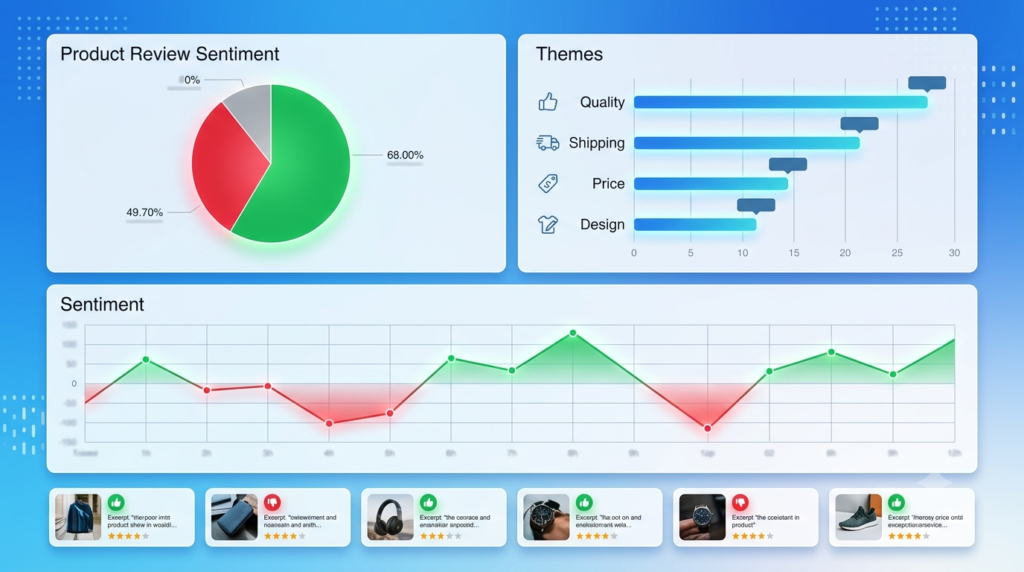
A product that ingests product reviews from e-commerce platforms, analyzes sentiment and themes, and produces actionable reports — helping small retailers understand customer feedback at scale without reading thousands of reviews manually.
Who Is This For?
- Small e-commerce store owners with 50-5,000 product reviews who can’t read them all manually
- E-commerce managers at growing brands who need to understand customer sentiment trends
- Product teams looking for specific feature requests or complaints in review data
- Marketplace sellers on Amazon, Etsy, or Shopify who want to identify product issues quickly
The Problem
Product reviews are the most honest feedback a retailer can get, but most small retailers don’t have the tools or time to analyze them systematically. A store with 200 products and an average of 30 reviews per product has 6,000 reviews to understand. Reading even 10% takes hours.
Enterprise tools like Qualtrics and Medallia cost thousands per month and require dedicated analysts. Free sentiment analysis APIs give you a positive/negative score per review, but that’s not actionable — a product might be “positive” overall but have a consistent complaint about sizing that drives returns.
The gap: small retailers need a tool that processes their reviews in bulk and produces specific, actionable insights — not just sentiment scores, but “32% of negative reviews mention late shipping” or “customers love the build quality but hate the packaging.”
How It Works
Review ingestion — Import reviews from Shopify, WooCommerce, Amazon, or CSV files. The system normalizes review text and metadata (rating, date, verified purchase).Theme extraction — Use NLP to identify the main topics discussed in each review (quality, shipping, price, sizing, customer service, packaging, etc.).Sentiment analysis — For each theme, determine whether the sentiment is positive, negative, or neutral. Track sentiment over time.Insight generation — Produce a report showing top positive themes, top negative themes, emerging complaints, and actionable recommendations.Analysis Dimensions
| Dimension | What It Measures | Example Insight |
|———–|—————–|—————–|
| Theme detection | What topics are discussed | “Quality,” “Shipping,” “Price,” “Design” |
| Theme sentiment | How customers feel about each theme | “Quality: 82% positive” |
| Trend detection | How sentiment changes over time | “Shipping complaints increased 40% last month” |
| Comparison | Product vs. product or category vs. category | “Product A has 2x more sizing complaints than Product B” |
| Urgent issues | Sudden negative sentiment spikes | “3 negative reviews in 2 days about broken zipper” |
Core Workflow
Review Sources → Text Preprocessing → Theme Extraction → Sentiment Scoring → Insight Report
Review import — Connect to Shopify/WooCommerce APIs or accept CSV uploads. Normalize review text, ratings, and metadata.Text preprocessing — Clean review text: remove HTML, normalize case, handle emojis, split compound reviews into individual points.Theme extraction — Use a combination of keyword matching and transformer-based topic modeling to identify themes. Pre-trained themes cover common e-commerce topics; custom themes can be added.Sentiment scoring — For each theme mention, determine sentiment using a fine-tuned sentiment model. Handle negation (“not bad”), intensity (“absolutely terrible”), and mixed sentiments.Report generation — Aggregate theme-level sentiments into an actionable report with charts, tables, and recommendations.Key Features
- Multi-platform import — Shopify, WooCommerce, Amazon, and CSV file support
- Automatic theme detection — Discovers themes without manual configuration
- Custom theme tracking — Add brand-specific themes (e.g., “color accuracy,” “battery life”)
- Sentiment over time — Track how customer feelings about specific topics change month to month
- Product comparison — Compare sentiment profiles across products or categories
- Urgent issue alerts — Get notified when negative sentiment spikes on any tracked theme
- Exportable reports — PDF and CSV reports for sharing with teams
- API access — Query sentiment data programmatically for integration with existing tools
Technical Architecture
┌─────────────────────────────────────────────┐ │ Review Sources │ │ (Shopify API / WooCommerce / CSV Upload) │ └──────────────────┬──────────────────────────┘ │ ┌─────────▼─────────┐ │ Text Preprocessor│ │ (Clean, normalize│ │ tokenize) │ └─────────┬─────────┘ │ ┌─────────▼─────────┐ │ Theme Extractor │ │ (Topic model + │ │ keyword match) │ └─────────┬─────────┘ │ ┌─────────▼─────────┐ │ Sentiment Engine │ │ (Transformer │ │ classifier) │ └─────────┬─────────┘ │ ┌──────────────┼──────────────┐ │ │ │ ┌───▼───┐ ┌────▼────┐ ┌────▼────┐ │Report │ │Alert │ │API │ │Engine │ │System │ │Server │ └───────┘ └─────────┘ └─────────┘
Technology Choices
| Component | Technology | Why |
|———–|———–|—–|
| Backend | Python + FastAPI | ML ecosystem, fast API |
| NLP | spaCy + Hugging Face transformers | Proven NLP pipeline |
| Sentiment | DistilBERT fine-tuned | Fast, accurate sentiment classification |
| Theme extraction | BERTopic | Automatic topic discovery |
| Database | PostgreSQL | Structured review and analysis data |
| Frontend | React | Dashboard and report viewer |
| Task queue | Celery + Redis | Async review processing |
MVP Scope
CSV import for product reviewsAutomatic theme extraction from review textPer-theme sentiment scoring (positive/negative/neutral)Summary dashboard with theme breakdown chartsBasic trend analysis (sentiment over time)Export to PDF reportImplementation Approach
Phase 1: Data Pipeline (Weeks 1-2)
Build the review import pipeline. Handle CSV uploads with flexible column mapping. Implement text preprocessing: HTML stripping, emoji handling, sentence splitting. Create the PostgreSQL schema for reviews, themes, and sentiment scores.
Phase 2: Theme Extraction (Weeks 3-4)
Implement BERTopic for automatic theme discovery. Build a pre-trained theme taxonomy for common e-commerce topics (quality, shipping, price, sizing, design, customer service). Add custom theme support.
Phase 3: Sentiment Engine (Weeks 5-6)
Fine-tune a DistilBERT model for product review sentiment. Handle negation, intensity, and mixed sentiments. Implement per-theme sentiment scoring.
Phase 4: Reports and Dashboard (Weeks 7-8)
Build the React dashboard with theme breakdown charts, trend views, and product comparison. Implement PDF report generation. Add email alerts for sentiment spikes.
Challenges and Tradeoffs
- Theme quality — Automatic theme extraction can produce vague or overlapping themes. The pre-trained taxonomy helps, but custom themes need enough reviews to train on.
- Sarcasm and irony — “Great quality if you enjoy things breaking after a week” is negative despite positive words. The transformer model handles some sarcasm but not all cases.
- Multilingual reviews — International sellers receive reviews in multiple languages. The MVP focuses on English; multilingual support is a future extension.
- Review authenticity — Fake reviews can skew sentiment analysis. The tool could flag suspicious patterns but should not make definitive authenticity claims.
Why This Idea Is Different
Free sentiment analysis APIs (Google Cloud NLP, AWS Comprehend) give you a sentiment score per review but don’t extract themes or provide actionable insights. Enterprise tools like Qualtrics cost thousands per month. Review management platforms like Yotpo and Judge.me focus on collecting reviews, not analyzing them.
This Idea combines theme extraction with sentiment analysis to produce specific, actionable reports: not “your reviews are 70% positive” but “customers love your product quality but 28% of negative reviews mention slow shipping, which increased 15% last month.”
| Tool | Focus | Limitation |
|——|——-|————|
| Google Cloud NLP | Sentiment scoring | No theme extraction, requires coding |
| MonkeyLearn | Text analysis | Generic, not e-commerce focused |
| Brandwatch | Enterprise social listening | Expensive, not review-focused |
| ReviewMeta | Amazon review analysis | Amazon-only, consumer-facing |
This Idea is specifically designed for small e-commerce retailers who want review insights without enterprise pricing.
Technology Stack
- Python 3.11+ — Backend and ML
- FastAPI — REST API
- spaCy — Text preprocessing and NER
- BERTopic — Theme extraction
- Hugging Face transformers — Sentiment classification
- PostgreSQL — Review and analysis storage
- Redis + Celery — Async processing
- React — Dashboard frontend
- WeasyPrint — PDF report generation
Future Extensions
- Amazon integration — Direct API import from Amazon Seller Central
- Multilingual support — Analyze reviews in Spanish, French, German, etc.
- Competitor analysis — Compare your sentiment against competitor products
- AI-generated responses — Draft replies to negative reviews
- Visual review analysis — Analyze photo reviews for product issues
- Real-time monitoring — Continuous review monitoring with instant alerts
Browse more E-commerce ideas · Product Ideas