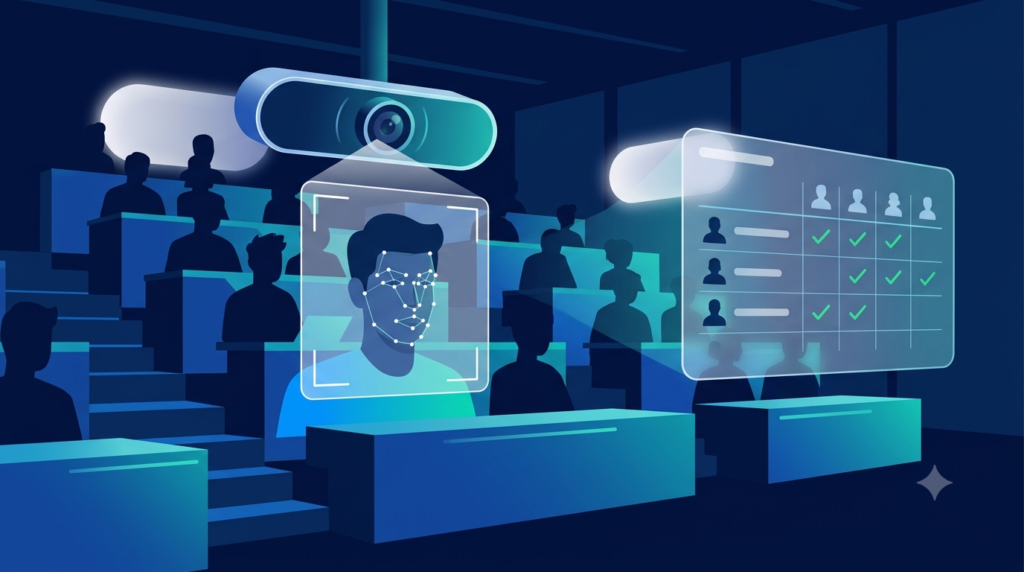
AI-Powered Campus Attendance via Facial Recognition
A research exploration of building a facial recognition system for automated campus attendance — examining the technical pipeline from face detection to identity matching, while addressing privacy, consent, bias, and responsible deployment in educational settings.
Who Is This For?
- CS researchers exploring computer vision applications in education technology
- Education technologists evaluating whether facial recognition can automate attendance
- ML engineers interested in face detection, embedding generation, and similarity matching pipelines
- Students and educators studying the ethical implications of biometric systems in schools
- Privacy advocates evaluating the technical tradeoffs of biometric attendance systems
The Problem
Manual attendance tracking consumes significant class time in universities and schools. In a typical 50-minute lecture, taking attendance by roll call can consume 5-10 minutes — time that could be spent teaching. For large lecture halls with 200+ students, the problem compounds.
Existing solutions fall into two categories: (1) card-swipe or RFID systems that require students to carry physical tokens and can be shared or loaned, and (2) commercial facial recognition attendance systems that are expensive, opaque about their accuracy, and often lack transparency about how biometric data is stored and processed.
The research question this Idea explores: Can an open, well-documented facial recognition attendance system be built that achieves practical accuracy while maintaining strong privacy protections and transparent consent mechanisms?
This is not a commercial product pitch — it is a research exploration with a testable methodology.
How It Works
The Facial Recognition Pipeline
The system follows a standard computer vision pipeline adapted for attendance tracking:
Camera Feed → Face Detection → Face Alignment → Embedding Generation → Identity Matching → Attendance Record
Step 1: Face Detection
The system detects faces in each camera frame using a pre-trained face detector. Modern face detectors (MTCNN, RetinaFace, BlazeFace) can detect multiple faces per frame with high recall, even under varying lighting conditions and partial occlusion.
Key challenges at this stage:
- Multiple faces per frame — A classroom may have 50-200 visible faces
- Lighting variation — Window-side seats may be brightly lit; back rows may be dim
- Occlusion — Students wearing masks, hats, or sitting behind others
- Camera placement — Front-mounted cameras see faces at an angle; ceiling-mounted cameras see top-of-head
Step 2: Face Alignment
Detected faces are aligned to a canonical pose using facial landmark detection. This normalizes for head rotation, tilt, and scale, improving matching accuracy. Typical alignment uses 5 or 68 facial landmarks (eyes, nose, mouth corners) to compute an affine transformation.
Step 3: Embedding Generation
Each aligned face is passed through a deep neural network (typically a ResNet or MobileNet architecture trained on face recognition datasets) that produces a fixed-length embedding vector (commonly 128-512 dimensions). Similar faces produce similar embeddings; different faces produce dissimilar embeddings.
Common models:
- FaceNet (Google) — 128-dimensional embeddings, trained on millions of face images
- ArcFace — State-of-the-art accuracy on academic benchmarks
- AdaFace — Adaptive margin-based training for diverse conditions
- MobileFaceNet — Lightweight model suitable for edge deployment
Step 4: Identity Matching
The generated embedding is compared against a database of enrolled student embeddings. Matching uses distance metrics (cosine similarity or Euclidean distance) with a configurable threshold.
Two approaches:
- 1:1 verification — Compare the detected face against a specific student’s enrolled face (used when the student is expected)
- 1:N identification — Compare the detected face against all enrolled students to find the best match (used for automatic attendance)
Step 5: Attendance Record
When a match exceeds the similarity threshold, the system records the student’s attendance with a timestamp, confidence score, and camera identifier. The threshold is a critical parameter: too strict and legitimate students are missed; too loose and imposters are accepted.
Enrollment Process
Before the system can recognize students, each student must be enrolled:
Photo capture — The student provides 5-10 photos under varying conditions (different angles, lighting, with and without glasses)Face detection and alignment — Each photo is processed to extract and align the faceEmbedding generation — Each aligned face produces an embedding vectorTemplate creation — The student’s enrollment template is the average (or centroid) of their enrollment embeddingsQuality check — Enrollment is rejected if the variance between enrollment embeddings is too high (indicating poor photo quality)Accuracy Considerations
Facial recognition accuracy depends on several factors:
| Factor | Impact | Mitigation |
|——–|——–|————|
| Lighting | Poor lighting reduces detection and matching accuracy | Use cameras with IR capability; ensure adequate classroom lighting |
| Pose angle | Large head rotations reduce matching accuracy | Use multiple cameras; mount at appropriate height |
| Occlusion | Masks, hair, accessories block facial features | Use models trained on partial faces; consider mask-aware models |
| Camera distance | Far subjects produce smaller face images | Use high-resolution cameras; zoom lenses for large halls |
| Expression changes | Extreme expressions alter face geometry | Use robust models trained on diverse expressions |
| Time gap | Students change appearance over semesters (haircuts, weight, aging) | Re-enroll periodically; update templates |
| Twins/siblings | Near-identical faces cause false matches | Use additional verification (student ID, PIN) for edge cases |
Published benchmarks for modern face recognition models on standard datasets (LFW, CFP-FP, AgeDB-30) report high accuracy rates, but these benchmarks use controlled conditions. Real-world classroom performance will be lower. A practical system should target:
- False acceptance rate (FAR):< 1% (accepting the wrong person)
- False rejection rate (FRR):< 5% (rejecting the correct person)
- Detection rate: > 95% (detecting faces present in the frame)
Technical Architecture
┌─────────────────────────────────────────────┐ │ Camera Array (Classroom) │ │ (USB cameras, IP cameras, or RTSP streams) │ └──────────────────┬──────────────────────────┘ │ ┌─────────▼─────────┐ │ Face Detection │ │ (RetinaFace / │ │ MTCNN) │ └─────────┬─────────┘ │ ┌─────────▼─────────┐ │ Face Alignment │ │ (Landmark-based │ │ affine transform)│ └─────────┬─────────┘ │ ┌─────────▼─────────┐ │ Embedding Network │ │ (ArcFace / │ │ MobileFaceNet) │ └─────────┬─────────┘ │ ┌─────────▼─────────┐ │ Identity Matcher │ │ (Cosine similarity│ │ + threshold) │ └─────────┬─────────┘ │ ┌──────────────┼──────────────┐ │ │ │ ┌───▼───┐ ┌────▼────┐ ┌────▼────┐ │Attend.│ │ Audit │ │ Dashboard│ │ Log │ │ Log │ │ & API │ └───────┘ └─────────┘ └─────────┘
Technology Choices
| Component | Technology | Why |
|———–|———–|—–|
| Face detection | RetinaFace | High accuracy, handles multiple faces well |
| Face alignment | dlib / MediaPipe | Fast landmark detection |
| Embedding model | ArcFace (ResNet-50 backbone) | State-of-the-art accuracy on benchmarks |
| Lightweight model | MobileFaceNet | Suitable for edge/CPU deployment |
| Similarity metric | Cosine similarity | Standard for face embeddings |
| Embedding storage | PostgreSQL + pgvector | Vector similarity search with SQL |
| Backend | Python + FastAPI | ML ecosystem compatibility |
| Camera interface | OpenCV + RTSP | Standard camera integration |
| Frontend | React | Attendance dashboard and enrollment UI |
| Deployment | Docker + optional edge device | Flexible deployment options |
MVP Scope
Face detection from a single camera feedEmbedding generation using a pre-trained modelStudent enrollment (photo upload and template creation)1:N identity matching with configurable thresholdAttendance logging with timestamps and confidence scoresBasic web dashboard showing attendance recordsAccuracy evaluation on a synthetic or public datasetImplementation Approach
Phase 1: Core Pipeline (Weeks 1-3)
Build the face detection → alignment → embedding pipeline. Test on public face datasets (LFW, CelebA) to validate embedding quality. Implement the enrollment process with template creation.
Phase 2: Matching and Logging (Weeks 4-5)
Build the 1:N identity matcher with configurable thresholds. Implement attendance logging with PostgreSQL storage. Build the enrollment API and basic enrollment UI.
Phase 3: Camera Integration (Weeks 6-7)
Integrate with USB and IP cameras using OpenCV. Implement multi-face detection and tracking across frames. Add frame rate optimization for real-time processing.
Phase 4: Dashboard and Evaluation (Weeks 8-9)
Build the React attendance dashboard with real-time attendance updates. Implement accuracy evaluation metrics (FAR, FRR, detection rate). Create the audit log and attendance reports.
Challenges and Tradeoffs
- Accuracy vs. privacy tension — Higher accuracy requires more enrollment data (more photos per student), but more data increases privacy risk. The system must balance these concerns.
- Real-time processing — Processing video frames for 200+ faces requires efficient GPU utilization or edge processing. CPU-only processing may be too slow for large classrooms.
- Template aging — Student appearances change over months. Without periodic re-enrollment, accuracy degrades. The system should flag low-confidence matches and prompt re-enrollment.
- Environmental factors — Classroom lighting, camera placement, and seating arrangements significantly affect accuracy. The system must be robust to real-world conditions.
Ethical and Privacy Considerations
This section is critical for any facial recognition deployment in educational settings.
Consent Requirements
- Informed consent — Students must be explicitly informed that facial recognition is used for attendance and must consent before enrollment
- Opt-out alternative — An alternative attendance method (QR code, manual sign-in) must be available for students who do not consent to facial recognition
- Parental consent — For minors (K-12), parental or guardian consent is required in most jurisdictions
- Right to deletion — Students must be able to request deletion of their biometric data at any time
Data Protection
- No permanent face storage — Store only embedding vectors, not raw face images. While embedding reverse-engineering research exists, storing only embeddings rather than raw images significantly reduces privacy risk
- Encryption — Encrypt embedding vectors at rest and in transit
- Access control — Restrict access to enrollment data and attendance logs to authorized personnel only
- Retention policy — Define and enforce data retention periods (e.g., delete enrollment data after graduation)
- Breach response — Have a plan for biometric data breach notification
Bias and Fairness
Facial recognition systems have documented performance disparities across demographics:
- Race/ethnicity — Some models show higher error rates for darker skin tones (Buolamwini & Gebru, 2018)
- Gender — Some models show higher error rates for women
- Age — Performance varies across age groups
- Accessibility — Students with facial differences or disabilities may experience higher false rejection rates
The system should:
- Test for demographic bias before deployment
- Report accuracy disaggregated by demographic groups
- Provide alternative attendance methods for affected students
- Monitor for bias continuously after deployment
Legal Compliance
- GDPR (EU) — Facial recognition data is biometric data under GDPR Article 9. Requires explicit consent or substantial public interest justification
- BIPA (Illinois, USA) — Biometric Information Privacy Act requires informed consent and prohibits selling biometric data
- FERPA (USA) — Student education records are protected; attendance data linked to biometrics may fall under FERPA
- Local regulations — Many jurisdictions have specific rules about biometric data in schools
This Idea does not constitute legal advice. Any deployment must consult with legal counsel familiar with applicable biometric privacy laws.
Suitable Datasets for Research
For developing and testing the system without deploying in a real classroom:
| Dataset | Size | Use Case | Access |
|———|——|———-|——–|
| LFW (Labeled Faces in the Wild) | 13,000+ images | Face verification benchmarking | Public |
| CelebA | 200,000+ face images | Face attribute analysis | Public |
| CASIA-WebFace | 500,000+ images | Face recognition training | Public |
| VGGFace2 | 3.3M+ images | Large-scale face recognition | Public |
| Synthesized classroom data | Custom | Testing multi-face detection | Generated |
Important: Do not use surveillance datasets collected without consent. Do not use datasets containing minors without appropriate ethical review.
Deployment Architecture Options
Option A: Edge Device (Per-Classroom)
- Raspberry Pi 4 or Jetson Nano per classroom
- Local camera connected via USB
- Processing happens on-device
- Results sent to central server via API
- Pros: No network video streaming, lower latency, simpler privacy model
- Cons: Hardware cost per classroom, maintenance overhead
Option B: Central Server (Campus-Wide)
- IP cameras in classrooms stream to a central server
- All processing happens server-side
- Results stored in central database
- Pros: Easier maintenance, centralized updates
- Cons: Network bandwidth, streaming video raises privacy concerns
Option C: Hybrid
- Edge devices for face detection and embedding
- Central server for matching and storage
- Pros: Balances privacy and maintainability
- Cons: More complex architecture
Recommendation for research: Start with Option A (edge device) for the smallest privacy footprint.
Research Methodology
Evaluation Metrics
| Metric | Description | Target |
|——–|————-|——–|
| True Positive Rate (TPR) | Correctly identified enrolled students | > 95% |
| False Positive Rate (FPR) | Incorrectly matched non-enrolled faces | < 1% | | False Negative Rate (FNR) | Failed to match enrolled students | < 5% | | Detection Rate | Faces detected in frame / faces present | > 95% |
| Processing Time | Time from frame capture to attendance record | < 2 seconds | | Enrollment Time | Time to enroll one student | < 5 minutes |
Experimental Design
Controlled testing — Test on public datasets first to establish baseline accuracySynthetic classroom data — Generate or collect multi-face images simulating classroom conditionsPilot testing — Small-scale deployment with volunteer participants (with IRB approval if academic)Accuracy evaluation — Measure FAR, FRR, and detection rate under varying conditionsBias evaluation — Test performance across demographic groupsUsability evaluation — Measure enrollment time, system reliability, and user satisfactionLimitations
- Not a production system — This is a research exploration, not a commercial product
- Accuracy under real conditions — Published benchmarks use controlled datasets; real classroom accuracy will be lower
- Privacy tradeoffs — Even with strong privacy protections, biometric data collection in schools raises ethical concerns
- Legal complexity — Biometric privacy laws vary significantly by jurisdiction
- Not a replacement for human judgment — Attendance tracking is an administrative function; facial recognition should complement, not replace, teacher discretion
Why This Idea Is Interesting
This Idea sits at the intersection of computer vision, privacy ethics, and education technology. It provides:
Technical depth — A complete facial recognition pipeline from camera to attendance logResearch value — A testable methodology with defined metrics and experimental designEthical framework — Comprehensive analysis of privacy, consent, bias, and legal considerationsPractical relevance — Addresses a real problem (manual attendance) that affects millions of students and educatorsOpen questions — Raises important research questions about biometric systems in educational settingsThe research angle differentiates this from commercial facial recognition products. The focus on privacy, consent, and bias makes it useful for researchers, educators, and policymakers — not just developers.
Browse more Education ideas · AI ideas · Research Ideas