AI-Powered Commit Message Generator
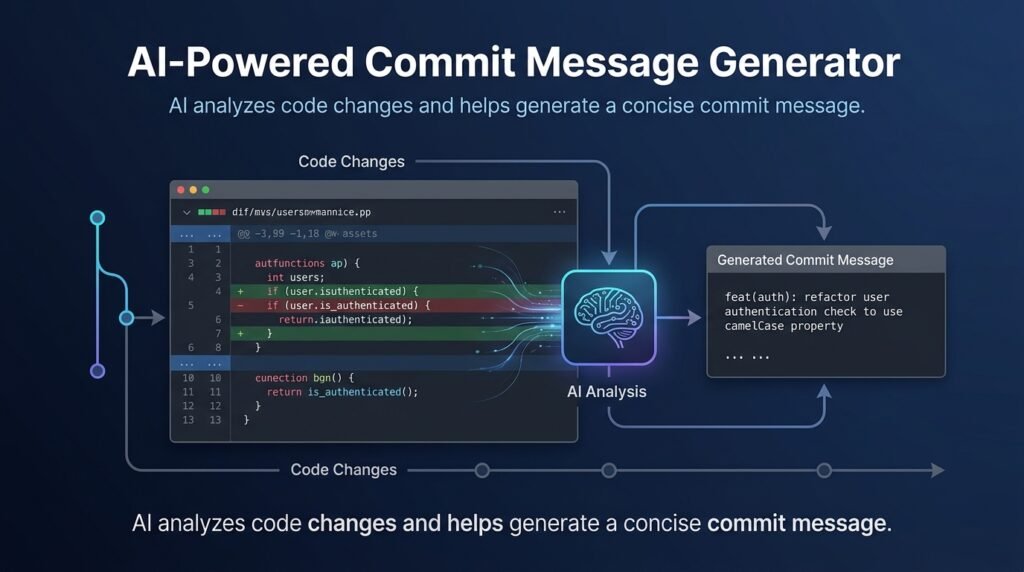
A command-line tool that reads the diff of your staged changes and drafts a concise, conventional commit message for you. The tool assists developers — it classifies the change, proposes a subject line, and optionally a short body — but it never commits on its own and never claims perfect understanding of your code. You review, edit, and approve every message before it lands in your history.
Who Is This For?
- Developers who want consistent, descriptive commit messages without breaking flow
- Junior developers and students learning how to write useful commit messages that explain why a change was made
- Teams standardizing on Conventional Commits who want the format enforced without the ceremony
- Open-source maintainers who review a steady stream of ambiguous “fix stuff” commits
The Problem
Commit messages are a form of communication with your future self and your teammates, yet most are written in five seconds and say almost nothing. “Update file” tells you nothing about intent. “Fix bug” doesn’t say which bug or why the change is safe. When someone runs git blame six months later, the message is the only record of why a line changed.
Writing good messages consistently is a low-value chore: the interesting work is in the diff, and the summary feels like paperwork. Teams respond with linting rules that reject bad messages, which only adds friction. What’s missing is a tool that does the summarization work and leaves the developer in control of the result.
How It Works
The tool works in four stages: read, classify, draft, and review.
1. Read the Diff
The CLI runs git diff --staged (or an equivalent for your VCS) and captures:
- the files changed and the number of lines added/removed per file
- the diff hunks themselves (with configurable size limits)
- the current branch name and the last few commit subjects for style context
2. Classify the Change
Before generating anything, the tool classifies the change into conventional types based on the files and diff content — feat for new behavior, fix for corrections, refactor, docs, test, chore, and so on. Classification is a hint, not a verdict: the user can always override it.
3. Draft the Message
A language model turns the diff summary into a candidate message:
- a subject line under 50 characters where practical (type + scope + imperative summary)
- an optional body explaining the motivation and notable trade-offs
- a breaking-change marker when the diff suggests one
The prompt is explicit that the message must describe what the diff actually does, never invent features, and flag uncertainty rather than guess.
4. Review Before Anything Happens
The tool prints the candidate message and waits. The user can accept it, edit it, regenerate, or discard. Only an explicit accept stages the commit. The model never commits, pushes, or rewrites history on its own.
$ git add src/parser.py tests/test_parser.py $ gcm generate ✎ feat(parser): support quoted identifiers in config values The config loader previously split on whitespace, which broke values containing spaces. This adds quote-aware tokenization and tests for single- and double-quoted cases.
[a]ccept [e]dit [r]egenerate [d]iscard: a ✓ Commit created: 1a2b3c4
Key Features
- Diff-grounded generation — messages describe what the staged changes actually do
- Conventional Commits option — enforce
type(scope): subject formatting when the team wants it - Human-in-the-loop review — accept, edit, regenerate, or discard; nothing is committed without approval
- Local or API model — run with a local model for fully offline, private use, or an API for higher quality
- Privacy-first defaults — a
--local mode never sends your code anywhere - Style context — picks up conventions from your recent commit history
- Editor/IDE integration — the same engine exposed as an editor command or pre-commit companion
Functional Requirements
Read the staged diff with git diff --staged (fallback: full diff when nothing is staged).Summarize changes per file: additions, deletions, and a coarse change type.Classify the change into a conventional type; allow manual override.Generate a subject line and optional body from the diff summary.Support local and API model backends behind one interface.Print the candidate for review and require an explicit accept before committing.Respect a .gcmrc config file for defaults (type mapping, body length, model choice).Never transmit code when the local backend is selected; log a clear warning when the API backend is used.Exit with clear, non-zero statuses on errors (no staged changes, model failure, user abort).User Stories
- As a developer, I want a ready-to-review commit message after staging changes, so that I keep my flow without writing the summary from scratch.
- As a team lead, I want Conventional Commits formatting applied consistently, so that changelogs and release notes can be generated reliably.
- As a student, I want to see why a message reads the way it does, so that I learn to write better commit messages myself.
MVP Scope
git diff --staged reading with per-file summaries.A single generation backend (start with an API; add a local-model adapter second).Conventional-type classification with manual override.Subject + optional body output with accept/edit/regenerate/discard flow.git commit executed only after explicit accept.A minimal config file for defaults.Multi-commit histories, IDE extensions, pre-commit hooks, and local-model support are natural second-phase additions.
Project Timeline
- Phase 1 — Research (Week 1): Study Conventional Commits, common commit styles, and prompt patterns for diff summarization; map the Git CLI API for diff access.
- Phase 2 — MVP (Weeks 2–3): Diff reading, classification, generation backend, and the review loop.
- Phase 3 — Testing (Week 4): Golden-diff fixtures, prompt-quality tests, and manual testing across real repositories.
- Phase 4 — Deployment (Week 5): Package as a pip-installable CLI, publish docs, add CI with a Python support matrix.
- Phase 5 — Improvements (Ongoing): Local-model adapter, IDE integration, style learning from history, and team feedback.
Testing Strategy
- Golden fixtures — a fixed set of diffs with expected message shapes; assert subject format and that the message references real changed files.
- Safety tests — the tool never commits without explicit accept; no prompt injection from file contents escapes into instructions.
- Classification tests — sample diffs classify into the expected conventional types.
- Error-path tests — no staged changes, empty diffs, and model failures produce clear messages.
- Manual smoke test — use the tool on a real feature branch for a week and review the resulting history.
Deployment Considerations
- Publish as a pip package; keep the zero-config path working (
pip install → gcm generate). - Pin Python versions and test in CI across the support matrix.
- Document the privacy difference between local and API backends prominently.
- Provide an uninstall path that leaves no background processes or scheduled tasks.
Security and Privacy Considerations
- Local mode sends nothing. With a local model, diffs never leave the machine. This is the privacy-first default for sensitive codebases.
- API mode is opt-in and loud. When an API backend is used, the tool should state that diff content is transmitted and let the user confirm.
- No secrets in messages. The tool should recognize and redact obvious secrets (API keys, tokens, passwords) from anything sent to a remote model.
- Least privilege. The tool reads the working tree and, on accept, runs
git commit. It never needs network access in local mode, and it never modifies files.
Success Metrics
- Time saved per commit (self-reported or measured as reduced context switching).
- Message quality: team survey on whether messages describe intent, plus consistency of
type(scope) usage. - Adoption signals: installs, stars, and weekly active users for an open-source tool.
- Safety: zero instances of an unapproved commit being created by the tool.
Common Challenges
- Diff size — large diffs blow past model context; chunking and per-file summarization are required.
- Prompt injection — code comments can contain instructions aimed at the model; treat the diff as untrusted input and keep the instruction layer separate.
- Model overconfidence — models invent plausible-sounding but wrong summaries; the review step and explicit uncertainty flags mitigate this.
- Message quality variance — API and local models differ; test both and set expectations per backend.
Learning Objectives
- Understand what makes a good commit message and how Conventional Commits work.
- Practice reading and summarizing diffs programmatically.
- Learn CLI design: subcommands, flags, prompts, and exit codes.
- Learn prompt-engineering basics: system/instruction separation and handling untrusted input.
- Practice human-in-the-loop tool design where the model assists but never decides alone.
Why This Idea Is Different
Commit-message linters tell you your message is bad. Commit-message templates give you a shape to fill. This tool is neither: it drafts the message from the actual diff and keeps a human in the loop. That makes it the commit-time counterpart to other AI developer tooling — it sits beside an AI-powered documentation generator for REST APIs and the AI code review assistant for Python teams as part of the same assistant family, but it solves a different job: summarizing your changes, not reviewing or documenting someone else’s code.
It is also deliberately a CLI with a local-model option, which is what makes it usable on private codebases where cloud tools are a non-starter.
| Tool type | Approach | Limitation |
|———–|———-|————|
| Commit message linters | Enforce format rules on messages you write | Don’t help you write the message |
| Commit templates / hooks | Provide a skeleton to fill in | Still manual; no summarization |
| Cloud AI commit tools | Summarize diffs via API | Send code off-machine; opaque prompts |
| Editor autocomplete | Suggest while you type | No diff awareness; message still hand-written |
This Idea’s differentiators: diff-grounded drafting, Conventional Commits support, a local-model mode for private code, and a review-before-commit loop.
Technology Stack
- Python 3.10+ — the CLI runtime
- Git CLI — diff access via subprocess (
git diff --staged) - An LLM backend — API (e.g., a hosted chat/completion model) with a local-model adapter as a second phase
- Typer or Click — CLI argument parsing and interactive prompts
- pytest — golden-fixture and safety tests
Future Enhancements
- Local-model adapter for fully offline operation
- Style learning from your repository’s commit history
- IDE integration (editor command, VSCode extension)
- Multi-commit generation for stacked changes
- Pre-commit hook that suggests a message when none is provided
- Team config sharing so conventions propagate through the repo
Browse more Artificial Intelligence ideas · Innovation Ideas